
The rupee fell 23 paise against the greenback to settle at a new all-time low of 91.01 (provisional) on Tuesday, weighed down by relentless foreign fund outflows, no breakthrough in India-US trade deal, and persistent US dollar buying.

The rupee plunged 38 paise to close at an all-time low of 90.32 against the US dollar on Thursday amid uncertainty over the India-US trade deal. Forex traders said the rupee is expected to trade with a negative bias as the delay in the trade deal between India and the US may continue to dent investor confidence.

Stock market is gearing up for an eventful week ahead where key triggers such as quarterly earnings from corporates, the US Fed interest rate decision and the upcoming Union Budget for 2026-27 would grab the limelight, analysts said.

Pharma major Dr Reddy's Laboratories (DRL) reported a 14 per cent year-on-year (Y-o-Y) drop in consolidated net profit to Rs 1,210 crore in the December quarter of FY 2025-26 (Q3FY26) on low sales of cancer drug Lenalidomide in the North American market. The firm's revenue from operations grew to Rs 8,727 crore in Q3FY26, a 4.4 per cent Y-o-Y increase from Rs 8,357 crore recorded for the same quarter last year.

'We are profoundly energy-dependent on the Gulf. That dependency must now be redirected towards the United States, because we require American permission to procure oil.' 'We additionally require Iranian permission to acquire oil from that source. So India now has to seek two separate permissions merely to secure its energy supply.' 'Should we be compelled to source from America, or from Venezuela -- which is, in effect, American-controlled supply -- that will inevitably carry a price premium, an elevated shipping cost, and a considerably extended delivery timeline, given the distances involved.'

Strong domestic growth will continue to draw foreign investment into the Indian economy, Reserve Bank of India (RBI) Governor Sanjay Malhotra said on Tuesday. He said this was reflected in recent free trade agreements and investment commitments by large technology companies.

The Reserve Bank of India (RBI) on Tuesday announced a fresh round of liquidity measures through open-market operations (OMOs) and a foreign exchange buy-sell swap, under which it will inject close to Rs 3 trillion into the banking system. The central bank said it would purchase Government of India securities worth Rs 2 trillion through OMOs, spread across four tranches of Rs 50,000 crore each to be conducted on December 29, January 5, January 12 and January 22.

The rupee plunged 26 paise to an all-time low of 90.75 against the US dollar in intra-day trade on Monday, weighed down by uncertainty over an India-US trade deal and persistent foreign fund outflows.

Days after an outage at MCX, Sebi chairman Tuhin Kanta Pandey on Tuesday expressed his displeasure over "repeated" instances of breakdowns at exchanges.

'In the long run, India's strong growth story and reforms to make assets globally attractive will determine the rupee's resilience.'

The rupee declined 22 paise to 87.41 against the US dollar in early trade on Thursday after the latest tariff announcements from the US weighed on emerging currencies, including the rupee. Forex traders said the latest tariff announcements from the US have sent shockwaves through global markets, strengthening the dollar.

The rupee breached 90-levels against the greenback for the first time on Wednesday, falling 6 paise to 90.02 in early trade, as banks kept buying US dollars at higher levels and FII outflows continued.

The Reserve Bank of India (RBI) has extended the trading hours for the interbank call money market from July 1, and that of repo and tri-party repo markets from August 1. Market participants said the decision is intended to help reduce the large Standing Deposit Facility (SDF) balances held by banks with the RBI, thereby addressing liquidity mismatches.

Importers are rushing to hedge their dollar positions amid the sharp depreciation of the rupee against the American currency and expectations of further volatility even as exporters are holding off after suffering mark-to-market (MTM) losses on earlier hedges.

In a bid to promote the use of domestic currency for cross-border settlements, the Reserve Bank on Wednesday announced a slew of measures, including allowing banks to lend in Indian Rupees to non-residents from Bhutan, Nepal and Sri Lanka for bilateral trade.

'Calibrated depreciation will help rebalance external fundamentals, offset some of the tariff differentials with competitors, improve the competitiveness of domestic substitutes vis-a-vis Chinese imports, and contribute to the easing of financial conditions at a time when the inflation rate is unusually low,' explains Sajjid Z Chinoy, head of Asia Economics at JP Morgan.

Escalating trade tensions amid a tariff war after Donald Trump took over as President of the United States (US) could adversely impact global growth and fuel inflation, an article on the "State of the Economy" in the Reserve Bank of India (RBI) monthly bulletin said.

The Indian government has expressed its disagreement with the IMF staff's 'baseline' assumption that the 50 per cent US tariffs on its goods exports 'would remain in place indefinitely', based on which the staff pegged the country's GDP growth at 6.6 per cent this year, and pared its 2026-27 projection by 20 basis points to 6.2 per cent.

In response to the panic triggered by Trump's trade policies, the RBI net sold approximately $43 billion in the second half of FY25 to curb volatility, as the rupee plunged to a low of 87.95 per dollar in February this year.

Those who have binged on credit must spend less, cut discretionary expenses, and focus on repayment.

Here's what Indian investors diversifying into equities, ETFs, and real estate abroad to manage risk, returns, and currency exposure must watch out for.

Titan, HCL Tech and State Bank of India were also among the laggards. However, Hindustan Unilever, Asian Paints, ICICI Bank, Power Grid, HDFC Bank and ITC were the gainers.
Domestic exporters on Monday expressed concerns over the crisis in Bangladesh and said the developments in the neighbouring country would have implications on bilateral trade. However, exporters expect that the situation may normalise soon. According to exporters, they are already facing disruptions in exports to Bangladesh due to a shortage of foreign exchange in that country.
The Reserve Bank of India's (RBI's) $10 billion US dollar-rupee buy-sell swap auction for three years received bids worth $16.23 billion on Friday, reflecting robust demand amid persistent liquidity deficit in the banking system. This was the second swap auction by the central bank after it infused $5 billion via six month-swap on January 31.

'Many global investors have been overweight on dollar assets, so some diversification or hedging is naturally expected.'

'The brand, the team, and the people have to make the transition from playing league matches to Test matches.'

'While investors believe in India's long-term growth story and resilience amid global uncertainty, they see near-term risks around the direction of a global trade war.'

The rupee breached the 80-mark against the dollar on Tuesday. The steady depreciation in the value of the rupee against the US dollar is likely to prove expensive for corporate India. The listed companies' revenue expenses in foreign currency or imports exceed their export revenues or revenue earnings in forex. In their latest financial year, BSE500 companies, excluding banks and non-banking finance companies and insurance (BFSI), reported combined forex expenses of Rs 12.31 trillion against forex earnings of around Rs 10 trillion.

Propelled by strong demand and lower costs, the country's largest airline, InterGlobe Aviation (IndiGo), reported solid operational performance in the 2024-25 (FY25) October-December quarter (Q3). While demand was driven by the festival season, year-end increase, and higher consumer spending, lower fuel and rental costs helped deliver a beat at the operating profit level.
The Reserve Bank has told the International Monetary Fund (IMF) that the objective of frequent interventions in the forex market is to curb excessive volatility, dismissing the Fund's rationale for reclassifying India's exchange rate regime. The IMF, following the Article IV consultation with the Indian authorities, reclassified the status of the exchange rate regime to "stabilised arrangement" from "floating" for period between December 2022 to October 2023. India's Executive Director at IMF K V Subramanian and Senior Advisors Sanjay Kumar Hansda and Anand Singh questioned the selection period adopted by the Fund for analysis and also reclassification of the country's exchange rate regime.

Exports dipped 1.6 per cent to 8.95 trillion yuan.

Corporate India is more dependent than before on exporters of IT services such as Tata Consultancy Services (TCS), Infosys, and Wipro for earning foreign exchange. Such companies account for nearly 43 per cent of the forex revenues of listed firms, up from 22 per cent a decade ago. The listed IT services companies earned nearly Rs 4.2 trillion through exports in FY22, up 15 per cent from the Rs 3.65 trillion a year earlier. In comparison, the forex revenues or exports of the rest of the BSE500 companies were down 11.9 per cent to Rs 5.6 trillion last financial year.

Among the Sensex firms, Kotak Bank, PowerGrid, ICICI Bank, HDFC Bank, PowerGrid were the major gainers. HUL, TCS, M&M, IndusInd Bank, HCL Tech were among the losers.
The Real Effective Exchange Rate (REER) of the rupee moderated in December to 107.20 after hitting a peak of 108.14 in November, latest data released by the Reserve Bank of India (RBI) showed. The REER was 103.66 in January 2024. The rupee depreciated around 3 per cent against the dollar in 2024.

The recent depreciation of the rupee along with sharp fall in the country's foreign exchange (FX) reserves has sparked a debate whether stability of the exchange rate is necessary and desirable. The rupee was one of the least volatile currencies among peers for almost two years before the current downward pressure started in September after the US Federal Reserve lowered interest rate.
Still the Reserve Bank of India will operate as usual and can provide funds via its overnight repo window, traders also said.
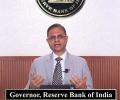
'India has the potential to grow at more than 7%, with the monetary policy providing a supportive hand.'

The RBI cracked down on offshore foreign exchange trading by Indians through online trading websites.

India's foreign exchange reserves have jumped to an all-time high of $651.5 billion as of May 31, Reserve Bank Governor Shaktikanta Das said on Friday. This means the overall kitty has increased by $4.83 billion since the last reported number of $646.673 billion on May 24 this year.

'A repo cut will be very good for the market as it will mean that everything is being done to spur growth in these uncertain times.'
